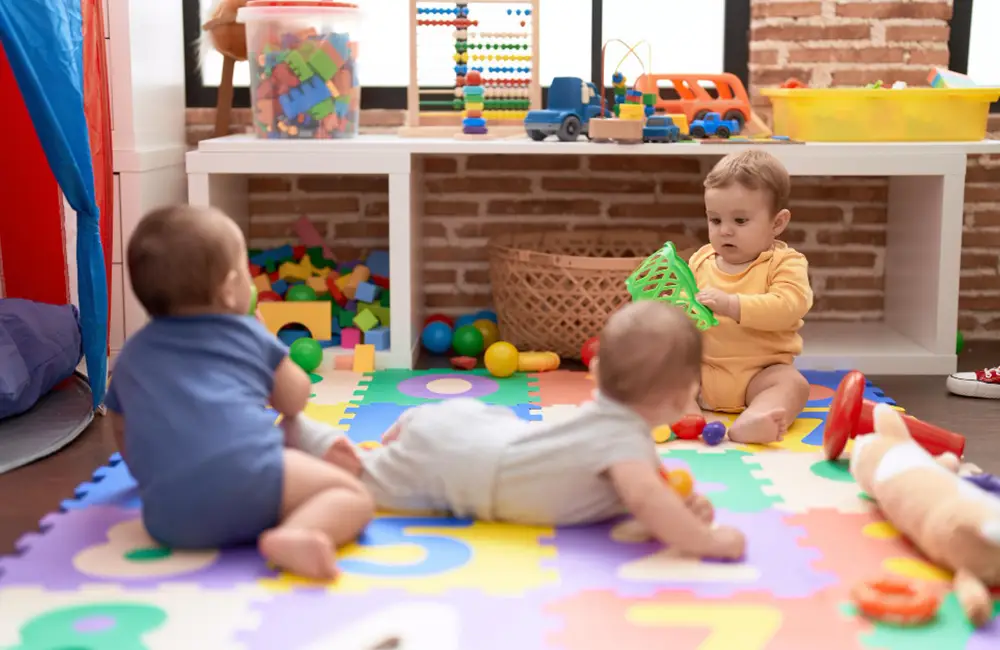
Watching your infant grow is a heartfelt ride for parents. They learn new skills every month. We refer to these minor developmental changes as motor skills.
Motor skills have two varieties. Large movements are a part of gross motor skills. Some gross motor skills in babies are walking and crawling. Fine motor skills include smaller movements, including holding a toy or picking up food. Let’s take a look at infant motor skills by month.
1. Birth to One Month
As you may already know, babies have very little control when they are born. The majority of motions are reflexes. When they are hungry, they turn their heads. This motion is an instant reflex, not a controlled movement.
At this stage, gross motor skills include raising their heads briefly. It isn’t steady, though. They make jerky movements with their arms and legs. They may briefly hold onto things before letting them go.
2. Two Months
They can raise their heads for extended periods of time, as this is an example of gross motor skill. When on their stomach, they can push up a little. The movements are shaky but more fluid than they were previously.
They begin to open their hands more frequently. They rarely grab things, but they can swipe at them. It’s a fine motor skill.
3. Three Months
Babies appear stronger by three months. When you put them on their stomach, they can lift their head and chests. They kick their legs more deliberately, showing gross motor skills developing.
If we talk about fine motor skills, they can open and close their hands. They can put their hands in their mouth. Above them, they can also bat at toys.
4. Four Months
Babies start to move more when they are four months old. Many babies can roll from stomach to back. When they sit with your help, they maintain their head stability. Their kicks are more powerful.
With their fine motor skills, they can grab toys. They have a little time to hold a rattle. They also bring toys to their mouths.
5. Five Months
Babies love to move by the time they are 5 months old. The primary gross motor skill at this stage is the ability to roll in both directions. They can sit with assistance. They can play with their arms even while lying on their stomach.
Babies learn some coordination. They can transfer a toy from one hand to the other. It highlights their developing fine motor skills. They shake and grab things. They use their mouths to check objects.
6. Six Months
Six months is a significant milestone. The infants will sit for brief periods of time without assistance. If you hold them upright, they can bounce. They begin to rock back and forth.
Fine motor skills include using both hands to grasp objects. They rub things against one another. They use their fingers to feel different textures.
7. Seven Months
Babies at seven months old enjoy exploring. They roll with ease. Many infants can sit unassisted. Some may also start crawling. Talking about fine motor skills, they grab food with a raking motion. They will hold two items simultaneously. They pay great attention to detail.
8. Eight Months
Better control comes after eight months. Gross motor skills development includes babies sitting comfortably on their own. They will try to crawl ahead, and some even accomplish it. They will pull up a little as well.
Fine motor skills include babies using their fingers to pick up small things. They have no trouble passing toys from one hand to another.
9. Nine Months
Nine months is a fascinating period. A lot of infants can crawl fast. To stand, they pull up. Some begin to hold on while moving along furniture. They use their thumb and finger to perform a pincer grasp. They will feed themselves with little snacks. Children intentionally drop objects to observe the results. It’s a good learning stage for infants.
10. Ten Months
Babies become adventurers at ten months. Among gross motor skills, they can hold furniture while standing. They can cruise sideways along furniture. Some even begin to take steps while holding both hands.
Infants use their fine motor skills to point at objects. They give a clap and like to bang toys together or stack blocks.
11. Eleven months
Babies want independence by the time they are eleven months old. They want to stand on their own due to advancing gross motor skills. A few make their initial moves. They can crawl upstairs if you allow them.
They use their fine motor skills to put items inside containers, and have no trouble picking up food. They give a bye-bye wave to guests as well.
12. Twelve Months
Babies surprise everyone when they are a year old. Many gross motor skills are self-sufficient. Some infants hold one hand while they walk. Some take their first step alone. They are adept at using the pincer grasp. They flip through a board book. They can easily stack two blocks.
13. Thirteen to Fifteen Months
During this stage, toddlers grow quickly. With the gross motor skills, the majority can walk independently. They squat to pick up toys and even learn to handle bigger objects.
If the baby uses crayons to scribble, it exhibits their fine motor skills. Shapes are inserted into corresponding holes. They use their fingers to feed themselves.
14. Sixteen to Eighteen Months
Skills develop by 18 months. Gross motor skills include toddlers being more balanced when walking. They ascend stairs with your help, but it is unsteady. Fine motor skills include using a spoon. They can stack 3 or more blocks together. They rotate lids or knobs.
15. Nineteen to Twenty-Four Months
Toddlers get really active from the age of 19 to 24 months. They function more efficiently. Infants can kick a ball and have no trouble climbing onto furniture.
They construct towers of four to six blocks with baby growth and development. They begin sketching basic lines. One by one, they turn the pages.
Actions to Improve Motor Skills in Babies
- Give infants room to move around safely
- Arrange play time every day
- Provide toys that are appropriate for the infant’s age
- Promote floor play
- Avoid walkers that restrict safe mobility
- Praise effort as well as achievement
Some babies develop skills more quickly, while others require more time. That’s typical in baby physical development phases. Consult a pediatrician if you are worried about delays.
In a Nutshell!
Early learning and baby growth are exciting aspects of infancy. Babies develop new strength and control every month. Every step is an accomplishment.
We celebrate these achievements daily at Growing Seeds Academy. We support the skills development in children. We provide a safe and secure environment where they can explore, learn, and grow. Book a visit to our facility today.
Frequently Asked Questions
1. What are motor skills in babies?
Motor skills are little movements like controlling the body.
2. When do babies start crawling?
Most babies start to crawl between 7 to 9 months of age.